This rolling carcass is the Congo. We don’t know where, but it’s going somewhere…”. These words by Freddy Bienvenu Tsimba describe one of his emblematic installations with a name that is, to say the least, programmatic: Encore un effort! Intertwined bodies are seen pushing a car in dry dock, an allegory for everyday survival in Kinshasa. Made up of spoons and forks gleaned from the streets of the Congolese capital by kids who sell them to the artist, this monumental piece sums up the art of scavenging that has irrigated Kinshasa’s creative scene for years. Growing up in Matonge, a bustling district of Kinshasa, the artist, now celebrated beyond his native continent, intends to demonstrate, not without a touch of irony, what “Kin la belle” has become: an open-air garbage dump, where the most inventive erect visionary works of art for a world after chaos.
Freddy Tsimba, the central character in System K, Renaud Barret’s documentary about this underground scene, is considered one of the godfathers of this extraordinary generation of creators. “As the raw materials of this country are stolen, the population recovers its own raw materials second-hand, which in Kinshasa is also called ‘the thirteenth commandment’: Démerde-toi. There’s no one to help you,” sums up the author of this manifesto film. Renaud Barret sees in these performances the vibrant testimony of a generation of artists intent on awakening the consciences of a country plundered by multinationals. “There has always been a culture of recovery and transformation in this city. Musicians have had to make do. Upcycling and recycling, very fashionable words in Europe, are lived without references, even if their creations may refer to conceptual artists like the Viennese Actionists. That’s the phenomenal strength of this techno-ghetto sound!” For if, in this transartistic vortex, we see a Kongo Astronaut wandering around and a performer smashing mass-marketed objects with a sledgehammer, we must recognize the musicians who have also adopted this art of recycling to build a soundtrack of beats made from junk.
Bebson de la rue, the recycled king of Kinshasa
It all began at the turn of the millennium with a kind of tropical Géo Trouvetou who intended to “ring the bell of nothingness”. While most of these groups emerged around the time of Kabila’s second election, almost all of them came through Avenue Kato, the open-air laboratory of Jean-Claude Elemba, better known by his nickname Bebson de la rue (Bebson from the street). “All I can do is connect with the energy of the street,” he smiled some twenty years ago. At the time, still plugged into hip-hop, he had just crossed paths in Kinshasa with Frenchman Jean-Louis Mechali, an erudite drummer rooted in improvisation who was running a parallel urban lute workshop in Bagnolet. This encounter changed the configuration of Bebson’s music, which he intends to “recover objects from life to create an original soundtrack of the city”. In other words, he sets up a sound ecology that is ignored, or rather invented, in situ. “Sound is listening. I work with these raw materials to create different sounds, a range that resembles our city.”
This is what Fulu Miziki, or “music from the trash” in Lingala, is all about. “You can make flowers grow out of this crap. Every morning, I go out with my bag to collect stuff that will be used to build my instruments.” An early dancer/rapper and member of the cult group Trionyx, founded by Bebson de la rue, Pisko was one of Bebson’s first activists, practicing this spontaneous, DIY form of recovery art. A quarter of a century later, he has created some strange sound machines, an instrumentarium as unlikely as its soundtrack – a jumble of beats and cans, cling and clang – is now unstoppable, like a surreal metaphor, immersing us in the cauldron that is Kinshasa.

Fulu Miziki, the ghetto’s imaginary superheros
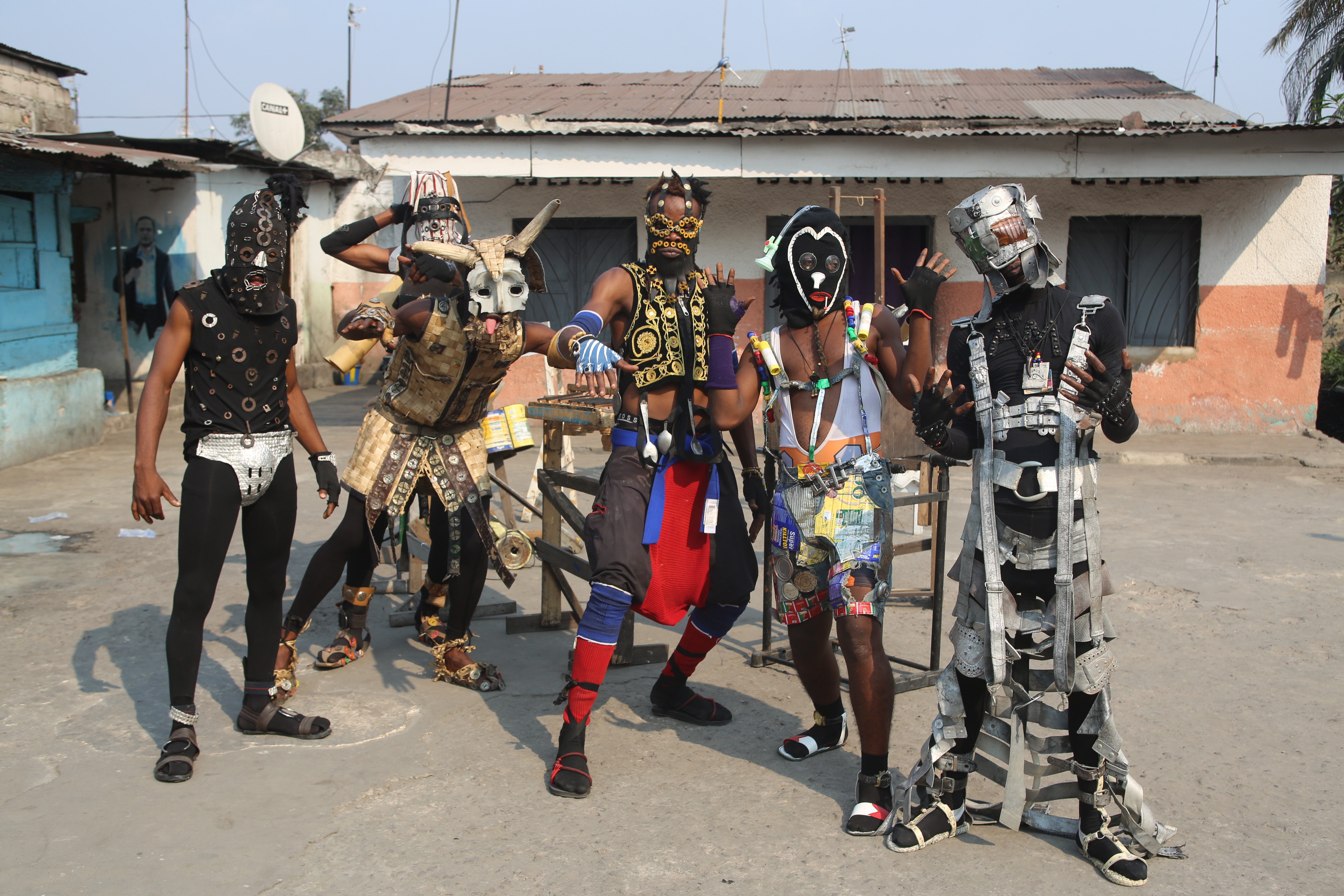
Plastic bags in shambles, cans of all kinds, worn-out tires, disemboweled carcasses – whatever a megalopolis of some 15 million inhabitants throws out can be reinjected into Fulu Miziki’s music. Bing bang boom. Just as, when rehearsing in the vast courtyard that served as their rehearsal room, in the heart of the labyrinthine Ngwaka district, a stone’s throw from the zoo and two blocks from the big Zando market, they sported patched costumes and imaginary animal masks. It was enough to give these heirs of Simon Kimbangu, the Congolese prophet who defied Belgian rule a century ago, a false air of ghetto superheroes. Mad Max 3.0 style.
Percussion drums made from saucepans and other kitchen utensils, cobbled-together cordophones, vibraphones made from agglomerated bits of plastic, vocoders made from a radio and a garden hose… Imagination here gives us the power to invent other sounds. “We were taken for fools. It was impossible for everyone to make music. They wanted to do what they always did: dress up, play masquerade music, be chic and elegant on the catwalk“, says Pisko. He chose the opposite path: using sound to demonstrate the harsh reality of a capital on the brink of collapse, where every day is a new challenge. And this aesthetic of organic chaos, organized into a scorching post-futurist trance, based on addictive hooks and acoustic loops, is as much about resilience as it is about the desire to blow things up. And so say the songs, which are rooted in the harsh reality of a city. “These are collective creations, like a form of cooperative democracy,” said Pisko in 2019. “The madman is the one who glimpses the truth, sees the future. Me, I dream of being able to invent what no one else has done.“
Kokoko, the DIY sound made in Kinshasa
Fulu Miziki perpetuates this faith in a brighter tomorrow. Afrofuturists? More like alert scouts of the daily hardships in a country rich in minerals, but excessively poor. Since then, failing to find their rightful place on the Congolese scene, Fulu Miziki have dug their furrow in Europe. Before them, another band of young tinkerers made waves on the other side of the Mediterranean. Their name? Kokoko, or knock knock knock. “We knock on the door, and even though we haven’t been let in, we’re already inside.” Five Congolese artists, most of whom were LoiX partners with Pisko, before setting up their own band, in the fertile groove of Bebson de la rue, by teaming up with the younger atalaku (crier), Makara Bianko, who sharpened his rhymes over crushed electronic beats at his club, Le Couloir de Bercy. Bicycles, tin cans, motorcycle gas pedal handles, typewriters… They’ve got their hands in everything! And there’s Love Lonkonde, who had his own adventures with Bebson, who adds: “We sing about social reality, the atmosphere, real life, the hardships of the country, but we hide so as not to get into trouble with the political authorities. You have to move forward masked, you have to protect yourself. You have to be strategic.”
The band’s first name, scouted on Western tracks, was the explicit Slum Robots. And their formula, more suited to Western ears, soon caught on, with the help of Débruit, a French producer and self-defined “musical explorer” who added layers and layers of sound to the ambient mess, which reminded him of “the punk funk side of New York in the late 1970s, the DIY attitude brings a totally different energy with something more direct in the electronic approach.” Not forgetting to mention Makara’s extra soul, his penchant for oblique and distorted sounds, the sense of noise and the science of feedback. “He lives 200% of what he sings! It’s like a battery charged to 200%, on the verge of exploding. When you’re next to him, it’s impossible not to be over-motivated.” Débruit concludes, “Kokoko is acoustic, electric and electronic! It’s a beautiful triangulation, where we navigate through each other’s influences in varying doses, and through these three types of sound sources. We influence and surprise each other, in a very spontaneous way.“

Certainly, but director Renaud Barret, who commissioned them to create the soundtrack for his film, is quick to see certain limits when it comes to performing in Europe. “The challenge is how to tune the wood they send out without restricting them! There’s a real sound constraint when it comes to putting this unstable instrumentarium on stage, where an E quickly becomes an F!” Their first album, “Fongala” (in other words, “the key”, which is normal given their name), manages to capture this energy of the moment, which could well refer to our future disenchanted building sites. “In Europe, some people won’t start playing guitar unless they have a certain type of guitar, or an album before they can get grants, etc. This softens artistic energy. Here, there’s a real freedom to create, to do without consuming, without waiting for money“, Débruit enthused. Like a necessary call to direct action, body and soul feverish on the black tracks, whose underpinnings are a dull anger, rumbling in the bass.
A long series of concerts and an album later, “Butu” released in the summer of 2024, only Makara Bianko from Kinshasa and Débruit from France remain from the original five-piece line-up. As a result, electronic music – notably Angolan kuduro and South African kwaito – has taken the place left by the ex-Slum Robots, and the eruptive power of DIY made in Kinshasa has taken a back seat. Instead, Renaud Barret tells us to keep an eye out for the sweet delirium of zagué, a style that mixes urban stories, typed rhythms and electro twiddling, while we wait for Nyata Zone, the tradi-modern soundtrack to the glory of Kinshasa’s gangs, which Makara champions.
Maître Tonnerre (Master Thunder) and his many avatars
While we wait for these to arrive in Europe, we can also get our fill of other variations on the formula tried and tested by Bebson. One of the latest is that of Wilfried Luzele Beki, better known as Lova Lova (among other nicknames for the man also known as Maître Tonnerre!). Associated with the sound machines of the enigmatic Gri Gri, he is leading a project called Article15, which is due to release its first EP in the summer of 2025, in reference to the constitution of South Kasai, which seceded. Others attribute this reference to Zaire. One thing’s for sure: this expression – Article 15 – has become part of everyday language in both Congo, to say that you have to manage to live!
“Opening your eyes will give you the brutal urge to gouge them out!” asserts Lova Lova, who before reaching this point made a name for himself on the streets of the Congolese capital. His first record, the self-produced Kizobazoba (or “patchwork”), featured Bebson de la rue and Bernard Morison, a tshegue, the children who haunt Kinshasa nights and for whom Wilfried later provided artistic direction for an entire record, “Mokili Na Poche”. A precocious church rapper, “Japanese” sapper, worshipper of the pioneering Zazou Bikaye project – more on that later! -Lova Lova was born in 1989, the year singer and Congolese monument Franco died – a sign of destiny – and found his own path in 2014, following the advice of photographer Kiripi Katembo Siku, another talent who died far too soon. Like the latter, who reflected Kinshasa through puddles, Lova Lova intends, with his broken voice, to show the other side of the picture, invoking the spirits of the ancestors who inhabit him as he straddles the stage like a tropicalized Sun Ra – one of his spiritual guides.
“To transcend this everyday life, I’ve created characters who are at my side, like the pharaoh whose costume I’m wearing. I look for sounds that come from parallel universes, embodying them with monstrosities.The world is coming to an end, and we might just make it through in post-apocalyptic mode. In 2050, the black man will become sperm due to excessive sex. Kinshasa will be liquefied and superior spermatozoa will build the stainless steel city of the future.” Inevitably, this prediction, uttered just before the budding Covid 19 epidemic, rings all the truer. “I’m not a very good singer, but when you’re in a trance, you transcend all that stuff about notes and scales. There are no limits, it’s beyond you! You’re no longer the same person, the mwotambo spirits come to inhabit you.”
Kin’Gongolo Kiniata, 100% original
Is it the same state of mind that inhabits those who go by the name of Kin’Gongolo Kiniata? In any case, they too embody a whole art of resourcefulness and tinkering, just like Bebson. “We all met at his place. Percussionists Ducap and Leebruno lived in the same neighborhood. I used to play drums in Trionyx, Bebson’s band. I used to go to his place to learn how to make instruments from recycled materials. That gave us the idea of doing the same thing,” recalls guitarist Julien, aka Bébé Mingé. They went on to create a sound identity based on “things like wood, plastic, saucepans…”. Clearly, the formula is still based on the same heretical foundation.
Esoteric loops, frenetic rhythms, a strato-bewitching guitar string, and over the top, bizarre vocals… There’s no doubt that these thirty-somethings are part of a long line of tradi-modernists who cobble together soundtracks based on instruments created from scratch. But also of Jupiter, the rebel general whom they recognize as “an older brother”. Like him, their music “is a blend of more Western sources, such as rock and electro, and traditional folk from back home. From Kasaï, but also from other ethnic groups like the Bakomo, the Baluba, the Mongo, like Bebson or Jupiter, as in people from the Congolese province of Equateur“, explains bassist Djino, also a singer like all the others in this big shaker typical of the alternative currents boosting Kinshasa’s creations.
“We took the name in reference to an onomatopoeia used by oil salesmen. At one time, there was a serious electricity problem in Kinshasa. Boys would wander the streets with a can of kerosene for lamps and a little tin can that made a very distinctive sound, kingolo, kingolo. Everyone in Kinshasa knew what that sound was! It was like an alert! The sound of light.” And Kiniata? “It means to crush. Our aim is to do things that are out of the ordinary, and to bring a different kind of energy to this country. We live in a super-polluted city, so recycling is good for the planet. Our message is above all positive.” And their greatest challenge, like all the others, “is to be able to propagate this music in our city, in the face of the all-powerful ndombolo (the modern avatar of Congolese rumba, nda)”. These recyclers of the wacky style have become contenders for the throne vacated by their elders.
Tshegué, Mental Bantu, Congo punk and heretic trance
Then there’s Tshegue, the musical UFO that bears the nickname of its singer and founder, Faty Sy Savanet. Born in Kinshasa, she landed in the Paris suburbs at the age of nine, and in 2017, she put a serious slap in the face of listeners. Since then, her raucous and soulful phrasing, enhanced by epileptic rhythms bordering on tribal trance, have exploded the duo onto the scene. Afro-punk? Congo garage? Voodoo trash? There’s no point in trying to attach a certified label to this unusual duo. “We don’t want to fit into any boxes. There’s no question of being this or that. No need to justify ourselves! We love rock, hip-hop, soul, funk and Cuban.” All in all, we’re talking about sounds that are viscerally tradi-modern, that draw on the deepest roots of music to create twists that turn clichés on their head. Black and white, in & out, arty and catchy, DIY and ghetto blaster, minimal and dense, sunny and dark, raw but sophisticated, spiritual and wild…

In a similar vein, there was also Bantou Mentale, two years earlier at the Transmusicales. “It’s a slightly mad band that could have existed in 1978, at the crossroads of cultures, in an urban flow that gives birth to an adventure towards music from elsewhere. Nothing to do with ethno-tourist clichés“, said Doctor L, the producer who distinguished himself just before with the wild Mbongwana Star, to describe the sound – half future funk half post punk – of this alternative contraband uniting Cuban ambient drummer Kabeya, a pure of Kin who was into tradi-modern delirium, and Franco-Congolese guitarist Chicco Katembo, ex of the Staff Benda Bilili galaxy. To this meeting of the third kind is added the voice of Apocalypse, a student of the Koffi Olomide orchestra. The result is something based at Château-Rouge station, the Paris district reminiscent of Matonge in Kinshasa. “There are small-time maquisards and bars, sappers and thieves, moms who run the business and the police, who have entered the game,” Cubain laughed. “It’s a whole fauna with incredible energy!” The same energy that infiltrated the often telluric, sometimes esoteric trance of this out-of-comfort-zone project.
Jupiter Bokondji, the rebel general of bofenia rock
In this inevitably incomplete review, it’s impossible not to return to the case of Jupiter Bokondji, who came to our attention twenty years ago after being the central character in “La Danse de Jupiter”. Against a backdrop of cobbled-together percussion, dented hip-hop and customized rumba, directors Renaud Barret and Florent de la Tullaye drew up an inventory of Kinshasa’s darker side. We discovered the so-called “Rebel General”. Red epaulets on a battered Russian jacket, he too, like Don Quixote, intended to stand up to the all-powerful ndombolo that’s shaking the buttocks of youth. Since then, the man who was born in 1963 in Kinshasa and spent the 1970s in Berlin has become an authority on the “stubborn generation, the sacrificed generation, the conscious generation”, in his own words. His formula? Bofenia rock, “a music of research”, blending all the influences that run through his mind. With Okwess (“food” in Kimbunda), a team of adventurers of the Congolese sound that he founded in 1990, he has gradually built up an out-of-the-ordinary identity that echoes that of his younger contemporaries, who tinker with a sound devoid of all clichés. “Coming out of nothing, or almost nothing, allowed me to get to the bottom of things. Otherwise, I’d just be an imitator, a musician. I’m an artist, I create my own path, and I know that it always takes time to be understood.”
Record after record, Jupiter has become a reference in Europe without abandoning its native soil, which fertilizes its original furrow. This is why Jupiter now devotes part of its energy to the “little ones”, through his organization Univers Jupiter, based in Lemba Terminus, a nursery that houses young groups: Arobase and Biakudja, Pic-Pic Wawa and Bankos, as well as Nelly, a singer who used to hang out with Bebson on the street, and his nephew Yende, a bassist who leads his own voodoo child-style delirium. “This very inspiring artist is like a big brother, with the same energy as us”, insists Aïcha, the ex-voice who machine-gunned at the microphone of the decapitating Fulu Miziki, with whom he co-wrote a song, Afrique sai sai (“the joy of Africa” – quite a program). True to his desire for the future, Jupiter hopes to spare the years of hardship he has endured with combos that diverge from the mainstream made in Congo. “Back to the roots of infinity, I tell you. They are the future of the musical revolution. These little Jupiters are stronger than I am. With them, we’re going to burn the world!” In any case, this is the wish of the man who has just released “Ekoya”, “It will come” in Lingala. A pious wish for a most curious mix, from crazy funk to customized ndombolo, featuring Soyi Nsele, a singer from the Mongo ethnic group.
Konono N°1, Kasaï All Stars and Bony Bikaye, the post-modern pioneers
This science of the great detour is certainly hopeful, and nothing new in the noisy Congolese capital. Ever since the tradi-modern movement, of which Kinshasa 1978, a compilation of unreleased tracks released ten years ago on Crammed Discs, gives a good idea, it’s become a classic for sound seekers. On zone, grooves based on homemade instruments and random amplification have earned themselves an appropriate name: research music. That says it all.
“Konono N°1 kicked things off by putting their likembes on big, ransacked amplifiers,” says Renaud Barret, who knows a thing or two about the subject. In addition to the group founded by Mingiedi Mawangu, who moved to the Congolese capital from his home region of Bacongo, where he cobbled together an amplification system from recycled materials to electrify his likembe, earning comparisons with Kraftwerk, Lee Perry, Jimi Hendrix and Miles Davis – a fine quartet to boot! then there was Kasaï Allstars, a collective of some 25 musicians from five groups, all from Kasaï, but from five different ethnic groups, each with its own culture, language and musical traditions, considered incompatible until these artists decided to join forces. Once again, their sophisticated yet wild sound will appeal far beyond their homeland.
A pioneer in this field, Vincent Kenis, distortion guitarist with Aksak Maboul and sound tracker for Belgian label Crammed Discs, predicted back in 2008 that “it all started around the time of the Ali-Foreman match, in 1974, which coincided with the great authenticity campaign launched by Mobutu, on the model of Sékou Touré. There was a flowering of orchestras, which recorded 45-tours. It’s no coincidence that last year, when the BBC trophy was awarded to Konono No 1, Hugh Masekela, the presenter of the ceremony, recalled that in 1974 there were orchestras like them at every crossroads in Kinshasa.” A decade later, Vincent Kenis was at the helm of the Zazou Bikaye adventure, a piece of history with the cult collection Noir et blanc, featuring Hector Zazou and Bony Bikaye. The Congolese-born Bony Bikaye was no stranger to success. Born in Kasai and raised in post-independence Kinshasa tcha-tcha-tcha, he had been thinking for some time of “bringing together Pygmy, or at least African, voices with the concepts developed by American Morton Subotnick, the first artist to record with machines”. In other words, he too had the intuition to tinker with an original soundtrack light years away from the miles of remote-controlled sounds.
In 1978, Bony Bikaye even proposed to the Secretary of State for the Voice of Zaire and the Director of Air Zaire that the country’s musical make-up should be redesigned. In other words, to leave behind the influence of Franco and Rochereau, who were dominating the airwaves at the time… Unfortunately, after a month, the misunderstanding had lasted too long for the man who was a fan of Stockhausen and Pierre Henry, all guys who had experimented on the radio. The future lay elsewhere for this atypical man, as for most of these experimenters, who found the most powerful sounding board, far too far from the Congo.