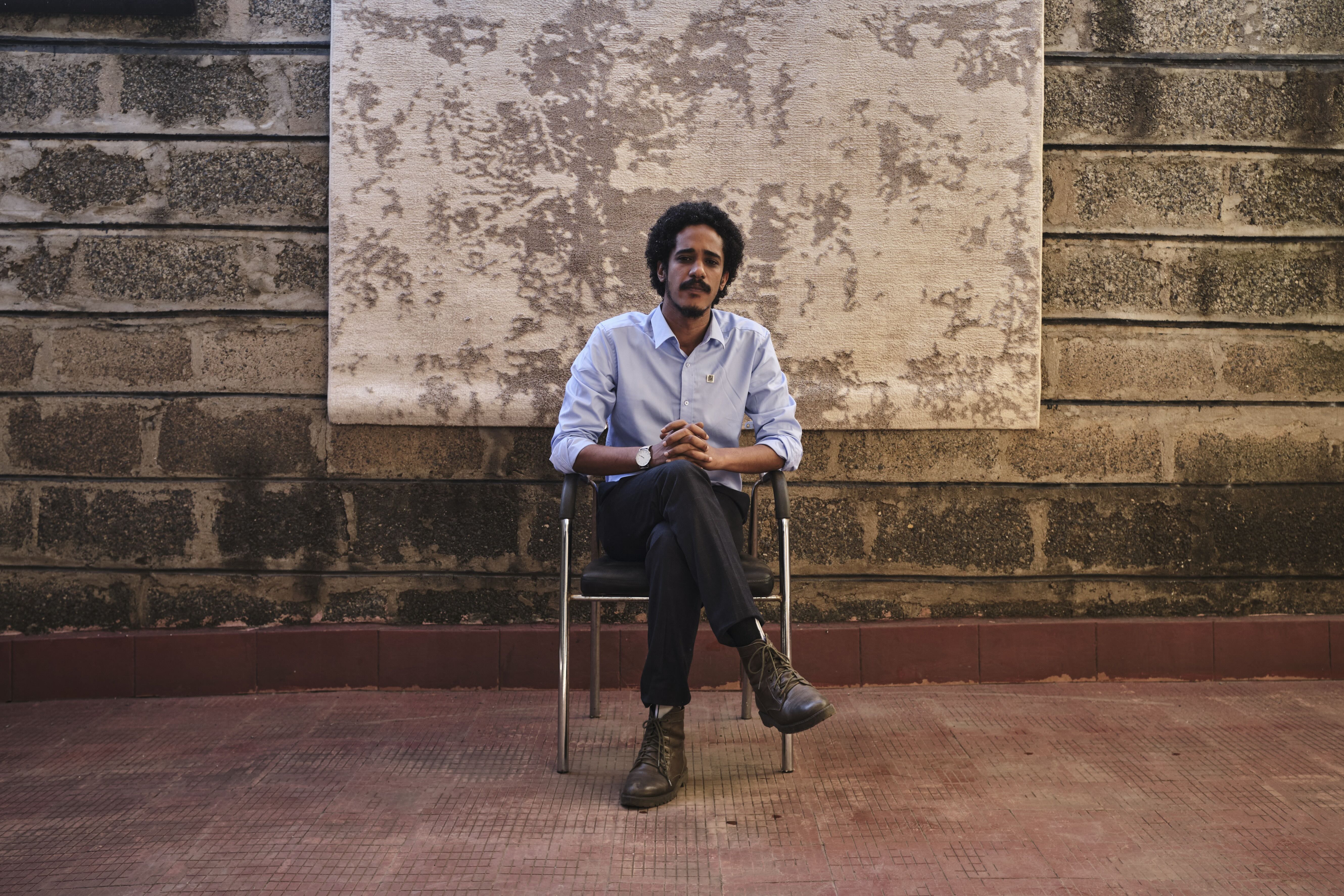
Ibrahim Ibn Albadya (Khartoum, 1990) rarely talks about why he chose to stay in Sudan after war broke out on April 15, 2023. “I usually don’t share it with anyone,” he says. “The past,” he explains, “can be a heavy burden—a stone in the road you can only move forward by stepping over,” and for him it’s exactly that: a reason to keep going.
Like millions of Sudanese, Ibrahim eventually fled—first to Addis Ababa, then to Nairobi—but only after spending two months holed up in his studio in a besieged Khartoum. From the safety of his home in the Kenyan capital, he recalls those days: “No food. No hospitals. Dead bodies in the streets. So much killing. It was madness.” Yet even as the bombs fell, one thing endured: his music.
Ibrahim is the frontman of Aswat Al Madina, or “The Voices of the City”, a band formed in 2014 that became the soundtrack of Sudan’s 2018 revolution, which toppled dictator Omar al-Bashir after 30 years in power. “There isn’t a single person in Sudan who hasn’t heard us,” Ibrahim says proudly.
More than just a band, Aswat Al Madina brought together musicians from across Sudan to blend traditional soundscapes, reimagined through a pop lens. Their songs captured the everyday struggle—youth unemployment, corruption, social injustice—but also the beauty of daily life. “We weren’t just creating music; we were creating messages that people used during protests,” says Ibrahim. “People chanted our lyrics in the streets. That’s how powerful it was.” He pauses before adding: “But we weren’t making protest music or revolutionary music. We’re artists—we seek beauty.”
Trapped in the studio
The past, present, and future of Aswat Al Madina collapsed the moment the Rapid Support Forces (RSF), led by Hemedti, rapidly took control of much of Khartoum and established themselves in residential neighborhoods. The Sudanese Armed Forces, commanded by de facto leader and army chief Abdelfattah al-Burhan, lost control of the capital, trapping hundreds of thousands of civilians inside it, and Ibrahim was one of them.
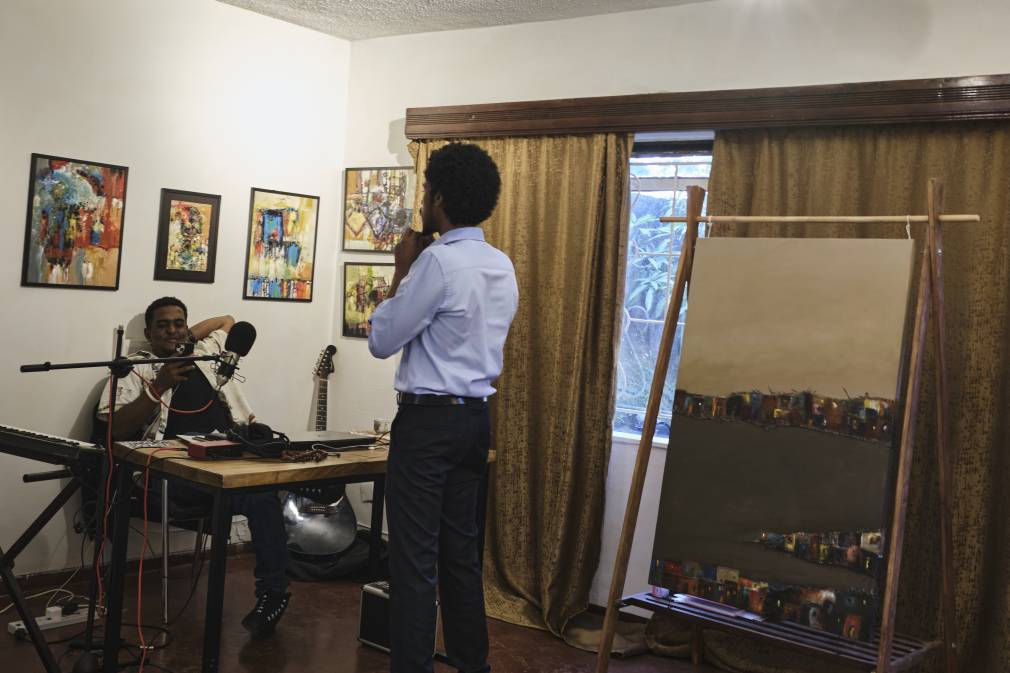
For the first two months of the war, Ibrahim lived in his studio—“a big villa filled with amps, drums, saxophones, recording equipment, with a beautiful collection of guitars and basses”—watching through his window as his city was destroyed day by day. “I decided I couldn’t stay silent.” With a fellow musician in El Obeid called Sarahan, he composed “An opportunity for Peace”, a track recorded remotely, trading files whenever power flickered back on amid shelling.
Eventually, Ibrahim fled to Gedaref in eastern Sudan, then across the border into Ethiopia, before reaching Nairobi. His bandmates scattered: some to Egypt, others to the UAE. He was the last to leave, carrying only a few clothes, a backpack, a laptop, and his sound card—objects which he still keeps in his home in Nairobi.
Music as resistance
Throughout his decade-long career in Sudan and now in exile in Nairobi, Ibrahim has never lost sight of his role as an artist. “Music—being a musician—is not just a trade. It’s a calling. It’s power. When you understand that this power comes from the people, you can’t do it randomly anymore. Every song is a decision, a responsibility,” he says, settling back on the couch.
The repressive socio-political climate under al-Bashir left no space for voices critical of the regime. Instead of directly confronting power, Aswat Al Madina learned to speak in metaphor. “We said things creatively, metaphorically… even subtly,” Ibrahim explains. One song, “Silsil Salwa”, seemed simple—a girl named Salwa, a necklace—but beneath it ran currents of corruption, love, resistance. During the Sudanese Revolution (2018–2019), a civilian uprising that lasted from December 2018 until al-Bashir was ousted in April 2019, those layers resonated deeply.
Even so, their music was not spared from state repression. Ibrahim was detained multiple times, beaten, and even received death threats from Bashir’s security forces. Their concerts were canceled and sabotaged, but, as he states, “they tried to silence us, but they couldn’t stop it reaching the people.”
Aswat Al Madina became the first band to tour the country, embarking on The Journey of Love and Peace: eleven days on a bus, playing city squares, bus stations, even airports. “Not just in cities,” Ibrahim recalls. “We went to remote states. We brought music to the people. I’ll never forget that.”
A future in exile
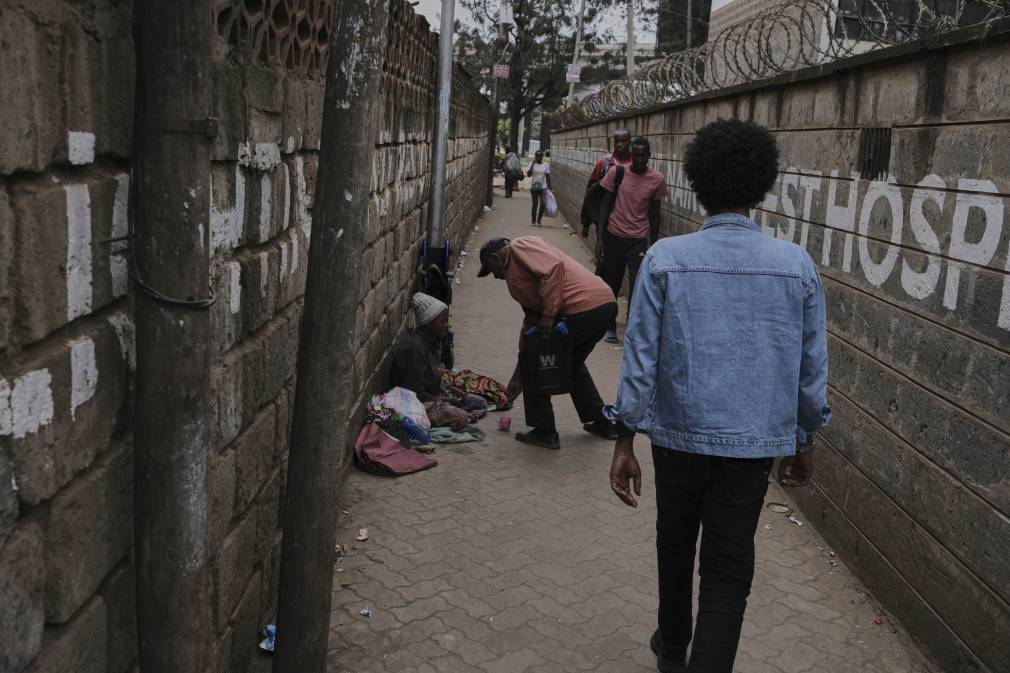
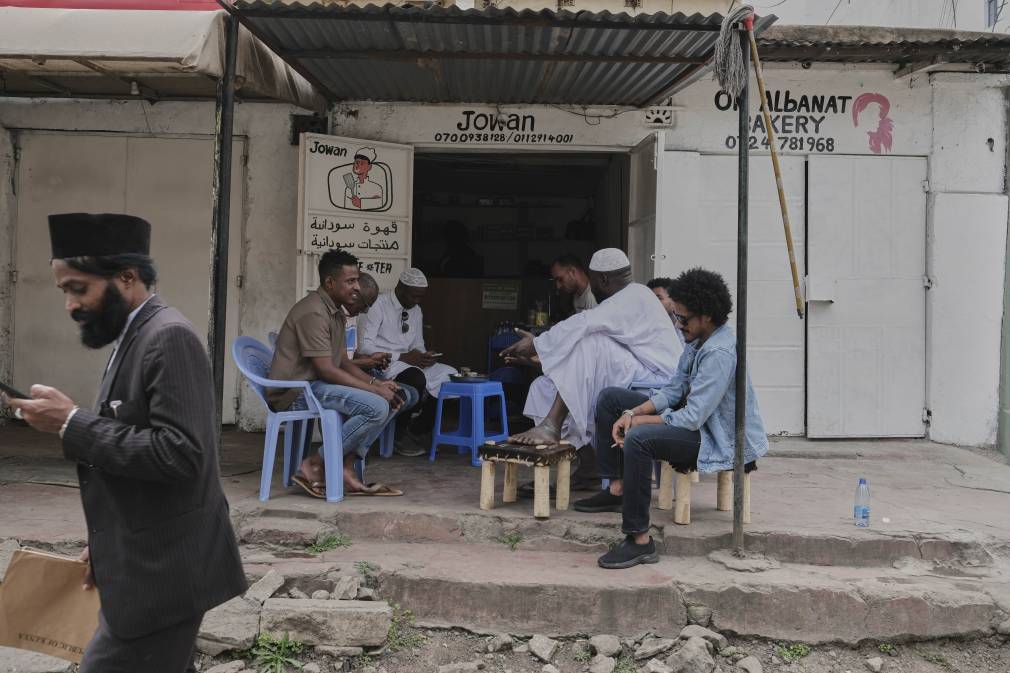
Hundreds of food vendors in pale jalabiyas run stalls in Nairobi West, a neighborhood where Sudanese communities have long settled. Children kick a ball around in front of Ibrahim’s two-story home, its living room lined with instruments resting against the walls. Sitting on his couch, he lights a cigarette before speaking. He takes his time to answer, he says, because he’s aware of the weight of his words—their reach, but above all, the responsibility they carry.
“I’m not going back,” he says.
Though an optimist by nature—he’s rebuilt his life more than once through music—he admits he’s worn down. “The war is just the cherry on top, but it’s not all. It’s everything before. Years of trying, hoping… I’m proud of what we did, but I can’t lose more years trying again.”
Nairobi is now his new base. “When I arrived, I started working again—gigs in cafes, music events… I had a few connections, so I started producing again.” He began collaborating with local artists, carving out a space in Kenya’s music scene, though without ever forgetting his roots: “My music is, always, by and for the people of Sudan.” Still, he admits that exile, the war, and having to rebuild everything time and again “shaped how I write, how I perform, how I connect with people.” The conflict has crushed many hopes that, he says, people still can’t shake off: “This needs to end.”
Keeping Sudan’s sounds alive
The lives of millions of Sudanese have changed beyond recognition. So has Ibrahim’s, but not the reason he’s always made music: to endure. “I don’t release a lot of songs now because if it doesn’t add value, it doesn’t matter to me. I want my music to matter, to be remembered.”
That desire to endure led Ibrahim, after arriving in Nairobi, to collaborate with Safeguarding Sudan Living Heritage, a project aimed at preserving and documenting Sudan’s traditional instruments so they aren’t lost. It’s a worldwide digital library where producers can access plugins he has developed. The bongoz, daloka, rababba, among others, are the instruments Ibrahim is digitizing—and thus immortalizing.
Ibrahim left Sudan, and though he is certain he won’t return, he knows a new generation is pushing to keep the country’s music alive. One of the names that has spread most in recent years is zanig, a vibrant, synth-based popular genre—usually played on a Technics 2000—whose influence has grown from urban areas to rural ones.
“I consider zanig music to be revolutionary, youthful, and deeply rooted in African rhythms, with a direct connection between Sudan and the rest of Africa. Zanig has faced widespread criticism, but its impact on Sudanese youth has been great,” says Ibrahim, who notes that Aswat Al Madina incorporated Zanig into their songs.
The consequences of Sudan’s war are immeasurable. It is a conflict not forgotten, but ignored by the international community, a war unfolding out of sight of the world, which the United Nations has called the “greatest humanitarian catastrophe on the planet.” Among its many casualties is a cultural loss seldom counted: that of art and artists—destroyed, silenced, or forced to flee. “Artists are messengers, and when we’re gone, there’s an absence. But someone will always come. A new generation will carry the message,” he concludes.
With a strong presence in Sudan since the 2019 coup, PAM | Pan African Music released Gidam (Until the End) in 2022, a documentary film by Arthur Larie and Bastien Massa. The following year, we presented a short documentary dedicated to the Tonjela project, which aims to collect and promote the country’s immense musical heritage in all its diversity. In Sudan, as elsewhere, music is political and social.